
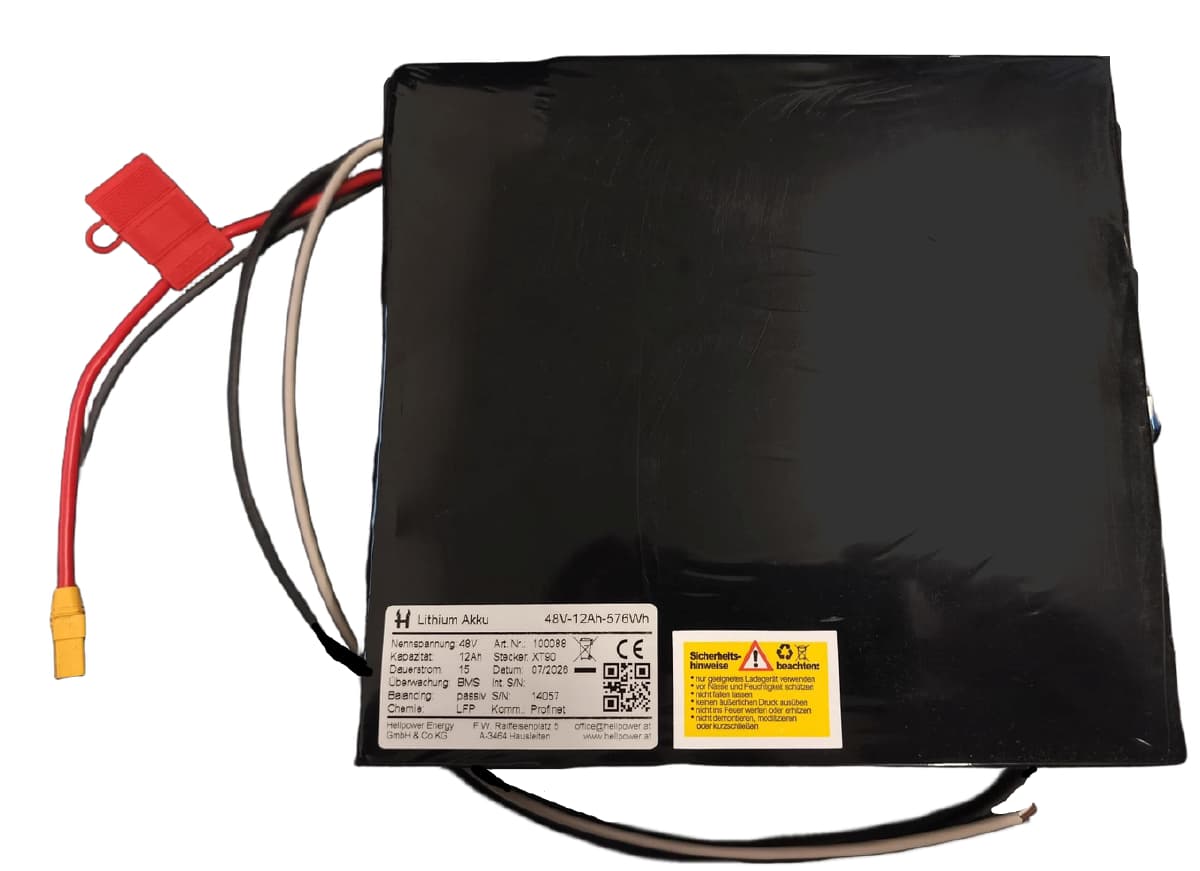
Why a "mute" battery becomes a problem in automation
A battery management system (BMS) that only switches off is not enough in mobile machines. An automated guided vehicle (AGV) that disconnects the battery without warning during operation ends up stranded somewhere in the hall under full load — in the worst case in the way, in a bottleneck or in the middle of a process. The controller has to know the state of charge, the temperature and the current before a limit is reached, not only afterwards through a fault message.
The state only becomes visible if the battery pack actively reports it to the outside. That is why an industrial battery pack needs, alongside the battery management system (BMS), a communication interface through which the controller continuously queries the relevant values. Only this data flow turns an energy source into a plannable component within the overall system.
Why Profinet — and not (only) CAN bus
In mobile machines the CAN bus is the classic fieldbus for BMS connection — robust, established, frugal. But as soon as the higher-level plant runs on industrial Ethernet, the controller speaks Profinet. That is the standard in the S7 world and across large parts of factory automation. Anyone wanting to connect a battery to a Siemens controller can hardly avoid Profinet as the fieldbus.
A battery that speaks Profinet itself fits directly into this engineering: via a device description (GSDML) the pack is integrated into the project like any other field device, hung into the existing Ethernet network over RJ45 and configured with defined process values. No CAN-to-Profinet gateway, no additional converter, no special handling — the battery is a node just like a drive, a sensor or a valve terminal.
Which values the battery reports over Profinet
What makes sense is exactly what the controller needs for its decisions. In practice these are: SoC (state of charge) — the remaining capacity, so the controller plans the route to the charging station before the lower limit comes within reach. Current — charge and discharge current in real time, as the basis for load management and plausibility checking. Voltage — the pack voltage as a fast operating indicator. Temperatures — separately for the BMS, the cells and the internal electronics, so a thermal anomaly is detected early.
If a cell reports a temperature anomaly, the controller throttles in an orderly manner instead of disconnecting hard. If the state of charge drops, it schedules charging before the vehicle stalls. The battery supplies the data — the operating strategy stays in the controller.
Onboard logging and remote maintenance
The communication electronics work independently of the pure protection BMS. They only draw current when the battery pack is activated — in storage the self-consumption is practically zero. Activation is via a potential-free contact, so the pack can be stored without self-discharge through the electronics.
In addition the battery pack logs onboard the most recent operating datasets and the timestamp of the last charge. As soon as the Profinet interface is active, the pack can be read out and serviced remotely — the basis for condition-based maintenance planning instead of rigid intervals.
Safe disconnection — safety with diagnostics over Profinet
Communication is not just comfort. Through a safety-related input "safe disconnect" — implemented as a potential-free contact — the plant can activate the BMS and deliberately disconnect the main line. The feedback of this state runs over Profinet and is thus part of the diagnostics.
Conceptually this corresponds to a single-channel architecture with diagnostics (category 2 per EN ISO 13849-1). Which performance level and which response time are achieved in the specific case depends on the component characteristics (B10d, MTTF_d) and the overall plant, and is formally assessed after the design freeze — together with the machine builder who places the machine on the market. The Profinet feedback provides the necessary diagnostic information for this.
Checklist for the Profinet battery connection
- ✓Device description (GSDML) available and the Profinet cycle time matched to the plant?
- ✓Process values defined: SoC, current, voltage and temperatures — including scaling and units in the telegram?
- ✓Activation of the communication module clarified (potential-free contact) and the standby current in storage acceptable?
- ✓Safety function “safe disconnect” with a target response time and category/PL per EN ISO 13849-1 agreed with the plant?
- ✓Diagnostic and fault codes defined and actually evaluated in the controller?
- ✓Charger and charge profile (CC/CV) matched to the battery?
- ✓Logging depth and remote-maintenance access defined — which datasets, at what interval, who accesses them?
The first points decide whether the battery fits cleanly into the automation project. The safety and diagnostic points decide whether it stays in controlled operation. Which values should run over the bus and how the safety function is connected to your plant, we are happy to clarify against your specification.