
Custom battery pack development
Custom battery pack development — bespoke lithium solutions from Austria.
Having a battery pack developed means more than choosing a cell: it is a complete development project from briefing to series readiness — with integrated BMS, defined form factor and full certification. Hellpower Energy has been developing and manufacturing custom lithium battery packs since 2004 in Hausleiten, Lower Austria.
Request a no-obligation initial assessmentWhen external battery pack development pays off
No standard pack fits
Form factor, voltage level or mechanical interface cannot be covered by catalogue products — a custom battery pack is the only reliable solution.
Certification required
CE, UN 38.3 or IEC 62619 are prerequisites for market access — documentation must be planned from the start of development.
Harsh or mobile operating conditions
Forestry, field instrumentation or AGV shift operation each impose their own requirements on protection class, temperature range and mechanical robustness.
Development process — from briefing to series readiness
A clearly structured process with a dedicated contact — no parallel projects that delay your battery pack.
1 — Technical briefing
Joint capture of all requirements: voltage level, rated capacity, maximum continuous discharge (C-rate), operating temperature range, form factor, communication interface (CAN, SMBus, UART) and quantity plan.
2 — Cell chemistry and system design
Calculation of energy, power and cycle life. Cell chemistry selection: LiFePO4 for safety and longevity in continuous duty, Li-NMC for maximum energy density, LTO for extreme fast-charge or low-temperature requirements.
3 — BMS design and form factor
BMS parametrisation for cell protection, balancing, state-of-charge calculation and communication protocol matched to your machine controller. Enclosure design to installation space and protection class (IP).
4 — Prototype and validation
Build of a fully integrated prototype battery pack. Functional and safety tests under real operating conditions, alignment of BMS parameters and mechanical installation situation.
5 — Certification and series readiness
Preparation of required documentation: UN 38.3 test evidence, IEC 62619 conformity, CE declaration of conformity. Transition to reproducible series production with fixed bill of materials.
LiFePO4 battery pack
Long-term stable cell chemistry for continuous duty and high cycle life — preferred choice for AGV/FTS and stationary industrial applications.
Li-NMC battery pack
High gravimetric and volumetric energy density — suited for instrumentation field devices and mobile machines with tight installation budgets.
LTO battery pack
Lithium titanate for extreme fast-charge cycles (under 15 minutes) or operation at −30 °C — e.g. for forestry machines in alpine territories.
BMS integration
Cell monitoring, active or passive balancing, overcharge and deep-discharge protection — CAN bus, SMBus or proprietary protocols to customer specification.
Small series from unit 1
Development and series production without minimum order quantities — from the first prototype to continuous series supply.
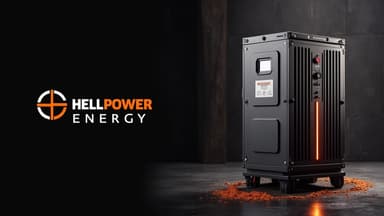
Case example
Battery pack for a mobile forestry machine
An OEM manufacturer of mobile forestry machines requires a battery pack for a hybrid drive: tight installation space in the machine frame, operation from −20 °C to +50 °C, vibration and shock loading to EN 60068, CAN bus connection to the existing machine controller, and UN 38.3 certification for road transport of the machine.
Hellpower defines cell chemistry (LiFePO4 for cycle life and low-temperature behaviour), BMS protection parameters, enclosure dimensions with IP65 protection class and CAN communication profile together with the OEM. Prototype and test phase under simulated field conditions conclude the development — series production starts with full CE documentation and UN 38.3 test evidence.
The battery pack is fully integrated into the machine controller, withstands the mechanical demands of field operation and is certified for international road transport. The OEM receives a dedicated contact for series deliveries and further product development.
Austrian development partner with project experience
2004
Hellpower Energy founded
✦
Developed to spec
UN 38.3
Dangerous-goods certified
Frequently asked questions
- What is the difference between a battery pack and a battery solution?
- A battery solution describes the complete system including charger and system integration. A battery pack refers specifically to the mechanically and electrically defined energy storage module — with cell stack, BMS, enclosure and connectors. This page focuses on the development and manufacturing of the battery pack as a standalone assembly for OEM integration.
- Which cell chemistries does Hellpower offer for battery packs?
- Hellpower develops battery packs with LiFePO4 (lithium iron phosphate) for longevity and safety in continuous duty, Li-NMC (lithium nickel manganese cobalt) for high energy density and LTO (lithium titanate) for extreme fast-charge and low-temperature requirements. Cell chemistry is determined by calculation — not selected from a catalogue.
- How long does development take to series readiness?
- No time estimate — the effort depends directly on the technical complexity of the battery pack, the scope of certification and the availability of customer data for the briefing phase. Hellpower provides a project-specific assessment after full requirements capture.
- Is Hellpower Energy limited to Austria?
- No. The development and manufacturing site is Hausleiten, Lower Austria. Hellpower supplies OEM customers in Austria, Germany and Switzerland as well as other DACH markets and exports certified battery packs within the EU.
- Which certifications are typical for a battery pack in mechanical engineering?
- UN 38.3 (dangerous-goods test evidence for transport), IEC 62619 (safety requirements for stationary and industrial lithium accumulators) and CE declaration of conformity to LVD (Low Voltage Directive) and EMC Directive. For machinery applications the integration into the machinery safety documentation to Machinery Directive 2006/42/EC is relevant. Hellpower supports documentation for all these certifications.
Reference industries and related solutions
Battery development
Custom battery solution development
The complete system: custom battery solution including charger and system integration — from requirement to series.
Small series
Battery pack small series from unit 1
From prototype to reproducible series — no minimum quantities, custom-made in Austria.
AGV & FTS
Lithium batteries for AGV & FTS
Custom battery systems for automated guided vehicles in shift operation.
Forestry
Battery packs for forestry machines
Robust lithium battery packs for mobile forestry machines — low temperature, vibration, IP protection.
Instrumentation
Battery packs for instrumentation
Compact Li-NMC battery packs for field measurement devices — dangerous-goods certification for air transport included.
Updated
Request battery pack development
Tell us about your application — we will explain which cell chemistry suits, which certifications are required and what the development process at Hellpower looks like.
Request a no-obligation initial assessmentOr call us directly: +43 2265 20775 0