

Hellpower Energy GmbH & Co KG

Case study · Heavy-duty intralogistics

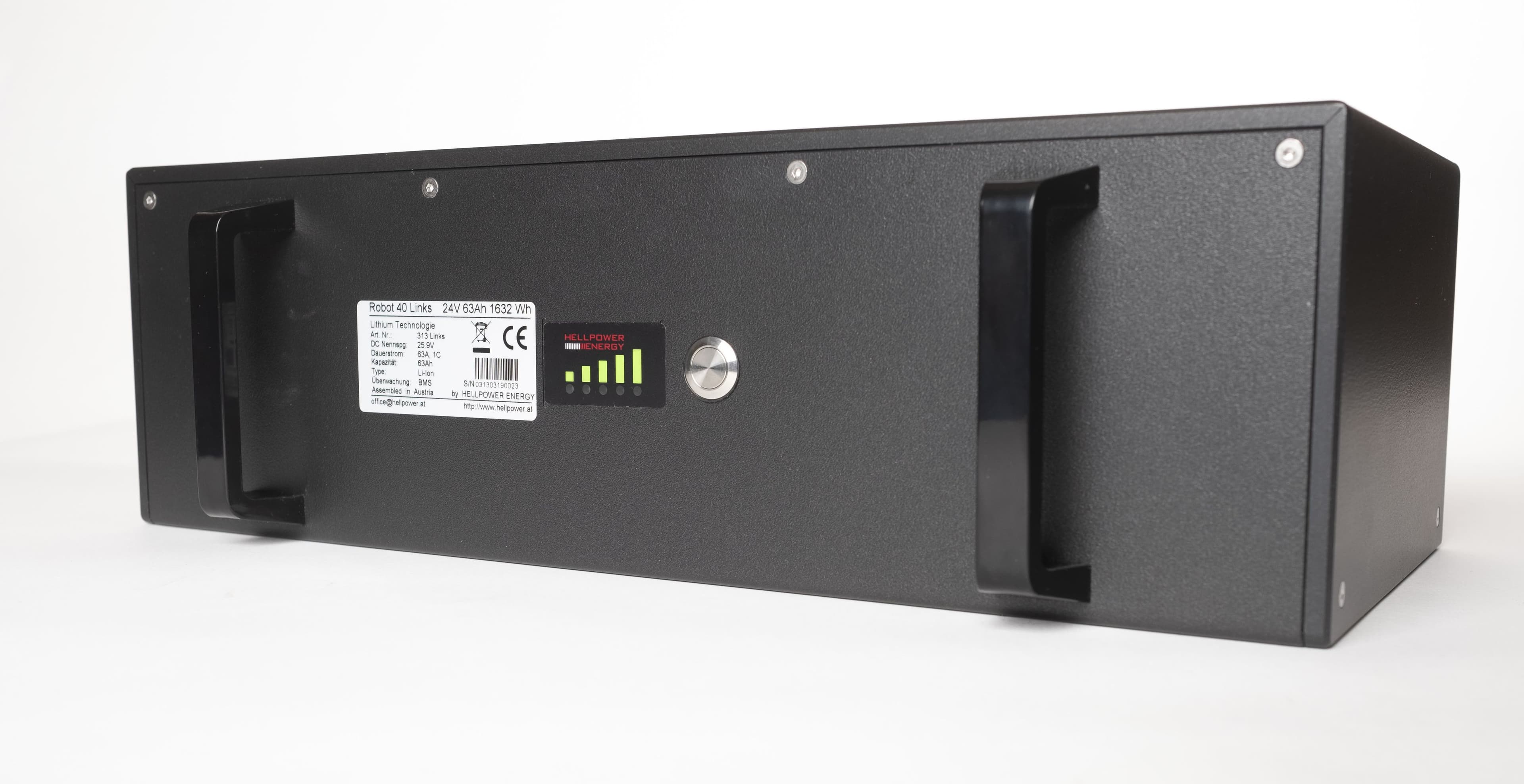
Lithium battery pack for heavy-duty AGV: two custom packs power the ROBOT-40 for wireless 40-tonne transport worldwide

Published Updated

Two custom lithium battery packs for the ROBOT-40 by Georg Kramp GmbH have replaced every standard battery that would have failed on dimensions, weight or power since 2013 — enabling wireless heavy-duty transport up to 40 tonnes in Japan, Europe and the USA.

ROBOT-40 by Georg Kramp GmbH with Hellpower lithium battery system — autonomous heavy-duty transport up to 40 tonnes

ROBOT-40, Georg Kramp GmbH & Co. KG — autonomous heavy-duty transport system

Georg Kramp GmbH Logo

Heavy-duty intralogistics

Georg Kramp GmbH & Co. KG

Background

Georg Kramp GmbH specialises in heavy-duty logistics and carries out industrial relocations and special transports worldwide, moving loads up to 40 tonnes. When heavy machinery must be moved under confined conditions — without a fixed track, without cables, precisely and safely — the ROBOT-40 comes in: an autonomous transport system that operates wirelessly and manoeuvres where conventional equipment cannot reach.

The partnership between Hellpower and Georg Kramp GmbH has been in place since 2013, established through a personal referral at the moment when the ROBOT-40 prototype was being developed.

The problem

No available battery system met the requirements. Lead-acid was ruled out: too bulky, too heavy, and unable to deliver the performance needed for this payload in this space. The vehicle had very specific installation dimensions — no standard housing came close. And the power requirements for 40-tonne operation were beyond what catalogue products delivered.

Georg Kramp GmbH was among the early adopters who switched to lithium in a heavy-duty specialist vehicle at a time when that was not yet common practice. Buying an off-the-shelf battery was not an option.

Requirements

  • Purpose-built housing: dimensions matched exactly to the available space in the ROBOT-40
  • Performance for 40-tonne payload: capacity and discharge power calculated for the vehicle's energy demand
  • Battery swap system: fast exchange during shift operations without modifying the vehicle
  • Matched chargers: charging and battery system specified as a coordinated unit
  • Worldwide operation: reliable performance in Japan, Europe and the USA across differing conditions

Solution

Hellpower developed two lithium battery packs with purpose-built housings. The starting point was the available installation space in the vehicle — the housings were designed to fit precisely without altering the vehicle structure.

The capacity and discharge performance of the packs were calculated based on the actual energy demand for 40-tonne operation. Together with partner companies, a battery swap system was developed that enables a fast exchange in continuous shift operation.

The chargers were matched to the battery packs and delivered together with them — charge time, charge-current profile and BMS-to-charger communication were aligned. The result is an integrated system in which no standard component undermines any other.

Outcome

Since 2013, the ROBOT-40 has run on Hellpower battery packs. The vehicle moves heavy machinery up to 40 tonnes — wirelessly, autonomously and reliably — in Japan, Europe and the USA. No standard battery has offered an alternative since: the housing geometry and performance parameters are so specific that the solution remains one of a kind.

"With Hellpower we finally found a partner who doesn't just supply batteries but who genuinely understood our challenge. Our application was too specific for standard solutions — and Hellpower developed one that fits exactly. This wasn't a supplier relationship — it was a real development partnership."

Managing Director, Georg Kramp GmbH & Co. KG

Technical background

Frequently asked questions

Why does a heavy-duty AGV require a custom lithium battery rather than a standard pack?
Standard battery packs are designed for standard dimensions and standard performance figures. A heavy-duty AGV like the ROBOT-40 has a very specific installation space and an exact energy demand for payloads up to 40 tonnes. No standard product covers both — neither the housing geometry nor the capacity and discharge power matched to the vehicle load.
What advantages does lithium offer over lead-acid in heavy-duty AGVs?
Lead-acid batteries are significantly heavier and larger for the same capacity. In an AGV, the extra weight directly reduces payload capacity and manoeuvrability. Additionally, lead-acid degrades when partially charged (sulfation), which becomes a problem in shift operations with frequent top-up charges. Lithium cells have a flatter discharge curve, tolerate partial cycles and typically achieve several times the cycle life.
How is battery swapping organised in autonomous transport systems?
In shift operations, fast and straightforward battery swapping is essential. For the ROBOT-40, a dedicated swap system was developed together with partner companies, enabling a quick exchange without modifying the vehicle structure. The battery packs are designed to sit securely in the vehicle and be removed in a single defined motion.
How are the battery pack and charger matched in heavy-duty applications?
The charger current must be low enough to protect the cells but high enough to fully recharge during an operating break. The charger communicates with the BMS and knows the voltage window of the specific pack. In the ROBOT-40 project, chargers were specified together with the battery packs — as a coordinated system from the outset.
What certifications does a lithium battery pack need for worldwide deployment?
UN 38.3 transport certification applies globally for lithium cells. Depending on the target market, additional certifications may be required. Beyond paperwork, the system must operate reliably across the temperature ranges encountered in Japan, Europe and the USA. The BMS monitors temperature, current and cell voltages, and limits charging at extreme temperatures.

Similar requirements?

When no standard battery fits — on dimensions, weight or performance — get in touch. We work through the technical parameters based on your application.

Discuss your requirements

Or call directly: +43 2265 20775 0